
Introduction
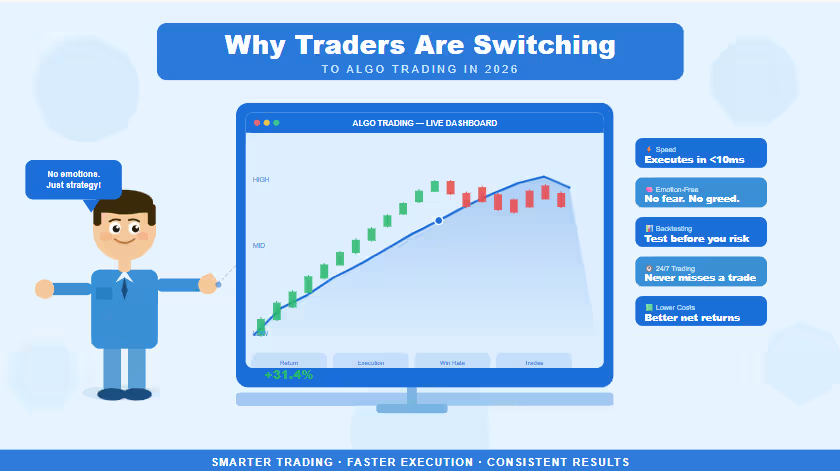
Over 70% of global trades today are executed by algorithms. Not because machines are smarter—but because they are more consistent than humans will ever be.
And in 2026, something interesting is happening.
Retail traders—the same ones who once relied solely on charts and instincts—are now shifting toward algorithmic trading as well. Why? Because it’s no longer complex or exclusive. Today, algo trading is easily accessible to anyone.
And here’s the real reason this shift is happening:
Most traders don’t fail because their strategy is wrong… they fail because they can’t follow it consistently. This is where algorithmic trading enters the picture. It eliminates hesitation, instills discipline, and enables you to consistently carry out your plan precisely as intended.
Let us ask you this simple question:
How often have you left too soon out of fear or stayed too long out of greed? How many times have you been watching a position that should have been managed automatically while glued to a screen at two in the morning?
If you recognize any of that, you are neither weak nor alone. You're a human. Furthermore, in 2026, the market is not waiting for people to catch up.
So what are smart traders doing in 2026 to make better, more strategic decisions?
They are using algorithmic trading.
While you were sleeping last night, algorithms executed millions of trades, identified dozens of patterns, and managed risk across 12 asset classes simultaneously.
The question isn't whether algo trading is the future—it is already the present. The real question is: are you part of it, or are you competing against it?
What Is Algorithmic Trading?
Algorithmic trading—also called algo trading, automated trading, or black-box trading—is the process of using computer programs to execute trades based on a pre-defined set of rules.
These rules can be as simple as “buy when the 50-day moving average crosses above the 200-day,” or as complex as a machine-learning model scanning 400 variables simultaneously.
No human clicks “buy.” No human panics and hits “sell.” The algorithm does it—instantly, consistently, and without emotional dilemma.
So what you do is:
You define your strategy clearly:
- Entry rules
- Exit rules
- Stop loss
- Target
Now the system does the work:
- Executes every valid trade
- Never hesitates
- Never feels fear
- Never revenge trades
- Never gets tired
Algo trading is not replacing you—it’s upgrading you.
Think of algo trading as your disciplined version, working 24/7 without emotional mistakes. Trading in a smarter way, backed by data and strategy—and, most importantly, aligned with market conditions.
In his masterclass, Kevin Davey highlights that consistency through rules—not human judgment—is what gives traders an edge.
What are the Benefits Of Algo trading?
Six Major Benefits of Algorithmic Trading are:
1. Speed & Precision
Algo trading executes trades in milliseconds—with accuracy and zero hesitation.
The average human reaction time is around 200–250 milliseconds. A basic algo system executes in under 10 milliseconds, while institutional systems operate in microseconds.
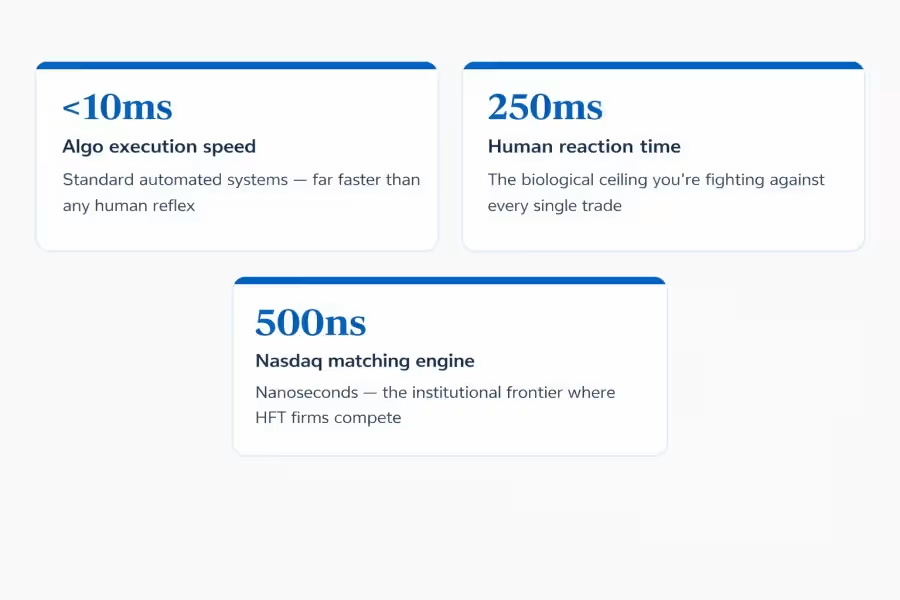
In fast-moving markets, this difference directly impacts your entry price. Even small delays can lead to slippage—the gap between your intended price and actual execution—which silently eats into profits.
By the time you click “buy,” the market has already moved.
That’s where algo trading gives you the edge—capturing opportunities with speed and precision before manual traders can react.
Suggested Reading: How Automated Algo Trading Software Works in India
2. Emotion-Free Execution
Algo trading operates on data and predefined rules, not emotions. It takes decisions based on market conditions and system logic, ensuring consistent and disciplined execution.
Ask any experienced trader about their biggest challenge—it’s rarely a lack of knowledge, but issues like hesitation, entering late, exiting too early, or overtrading at the wrong time.
Behavioral finance studies show that psychological biases, such as overconfidence and excessive trading, can reduce retail investors’ returns by about 1–3% annually compared to more disciplined approaches. Research
That’s exactly where algo trading helps retail traders. It works purely on data and predefined rules, not emotions. It simply checks whether the current setup meets the criteria—if yes, it executes the trade; if not, it waits.
Also Read: Is algo trading profitable?
3. Backtesting
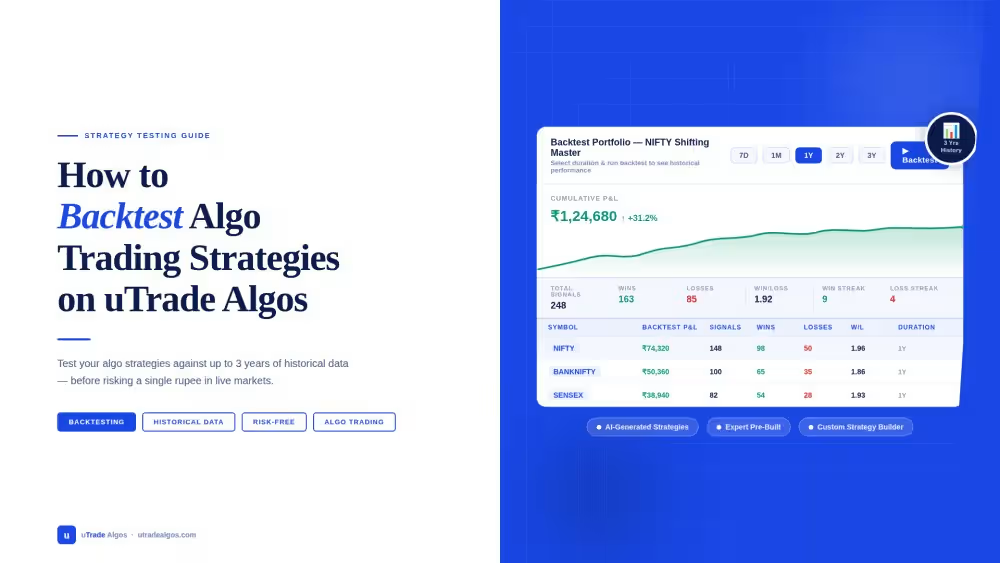
Here’s something no discretionary trader can do: go back in time and run your exact strategy across 10 years of market data to see how it would have performed—before risking a single rupee.
Backtesting is one of the most powerful advantages of algo trading. Before deploying a strategy live, you can stress-test it across different market conditions—bull markets, bear markets, sideways phases, COVID crashes, and post-election volatility. If your strategy fails in certain conditions, you discover it in simulation—not in your live account.
Cloud-based backtesting platforms now allow you to run parameter sweeps across years of data without needing expensive infrastructure. What once cost institutional firms millions is now available to retail traders through affordable subscriptions—or even for free.
Also Read: Is algo trading legal in India?
4. 24/7 Coverage Without Burnout
Indian futures open at 9:15 AM and close at 3:30 PM—but overnight gaps are often driven by global events that you can’t monitor manually.
With algo trading, your strategy runs while you sleep, eat, or go about your day. There are no missed signals because you were busy, and no need to stay up at odd hours tracking global markets. Your rules execute automatically—every time.
Multi-strategy and multi-asset deployment is another major advantage. While a human can focus on only one or two instruments at a time, an algorithmic system can manage multiple strategies simultaneously—such as a mean-reversion strategy in equities, a trend-following strategy in commodities, and a volatility hedge in options—all within one unified risk framework.
Suggested Reading: The Ultimate Guide: Understanding OI-Based Strategies in Algo Trading
5. Reduced Transaction Costs
Every trade has costs—bid-ask spread, slippage, brokerage, and taxes. These may seem small, but over hundreds of trades, they can eat up a big part of your profits.
Algo trading helps reduce these costs in smart ways:
It gets you better prices using efficient order execution
It places trades at the right time to avoid high spreads
It reduces slippage by executing quickly and precisely
For big traders, this makes a huge difference. But even for retail traders, small savings matter.
Example: If you make 500 trades a year with an average size of ₹2 lakhs, and you save just 0.05% per trade (₹100), that adds up to ₹50,000 extra profit in a year—without changing your strategy at all.
So if used smartly with proper rules and guidelines, algorithmic trading is beneficial in reducing transaction costs, which unknowingly get ignored while doing trading manually
6. Enhanced Liquidity
Algo trading increases market activity, which improves liquidity—meaning it becomes easier to buy and sell quickly, with smaller price differences, and at lower cost.
Suggested Reading: How to Build the Best Algorithmic Trading Strategy in 2025: 7 Essential Steps for Success
Want to understand algo trading better? We’ve explained it in detail in our podcast—give it a listen.
The Real Risks You Must Know
Algo trading is powerful — but it's not a magic money machine. Before you deploy your first automated strategy, you need to understand how these system work and what you must take care of.

Platforms like uTrade Algos help traders trade smarter by offering pre-built trading strategies that have been used by large financial institutions and experienced traders, and are approved by exchanges
- Backtest, forward test, and deploy strategies
- Build and deploy your own strategies
- Use AI to create and optimize trading strategies
Why Traders Are Switching to Algo Trading in 2026?
As of early 2026, algorithmic trading is experiencing rapid adoption in India, now accounting for over 50% to 70% of total trading turnover, particularly in derivatives and equity segments.
While the exact number of individual users is not publicly disclosed, the market has expanded significantly from institutional dominance to widespread retail participation, with algorithmic trading software growth driving increased market liquidity and efficiency.
What is making traders choose algo trading rapidly in 2026?
1. Emotional Discipline
Removes fear and greed, ensuring every trade follows a clear plan.
One of the biggest challenges in trading is managing emotions. Fear and greed often lead to poor decisions, such as exiting profitable trades too early or holding onto losses for too long. Algorithmic trading removes this issue by strictly following predefined rules. Every trade is executed exactly as planned, without hesitation or emotional bias.
2. High-Speed Execution
Financial markets move very quickly, especially in segments like options and intraday trading. Manual traders often miss opportunities because of delays in decision-making or order placement. Algo trading systems execute trades instantly, ensuring that opportunities are captured at the right moment.
3. Lower Trading Costs
Even small inefficiencies, such as slippage or delayed entries, can reduce overall profitability. Algorithmic trading minimizes these issues by placing orders with precision. Over time, better execution leads to reduced costs and improved net returns.
4. Improved Liquidity
As more participants use algorithmic systems, the number of buy and sell orders in the market increases. This improves liquidity, making it easier to enter and exit trades quickly. It also reduces the gap between buying and selling prices, which benefits all traders.
5. No-Code Accessibility
Earlier, algo trading required programming skills, which limited its use to professionals. Today, no-code platforms allow traders to build and deploy strategies without writing a single line of code. This has made algorithmic trading accessible to a much wider audience.
6. Strong Risk Management
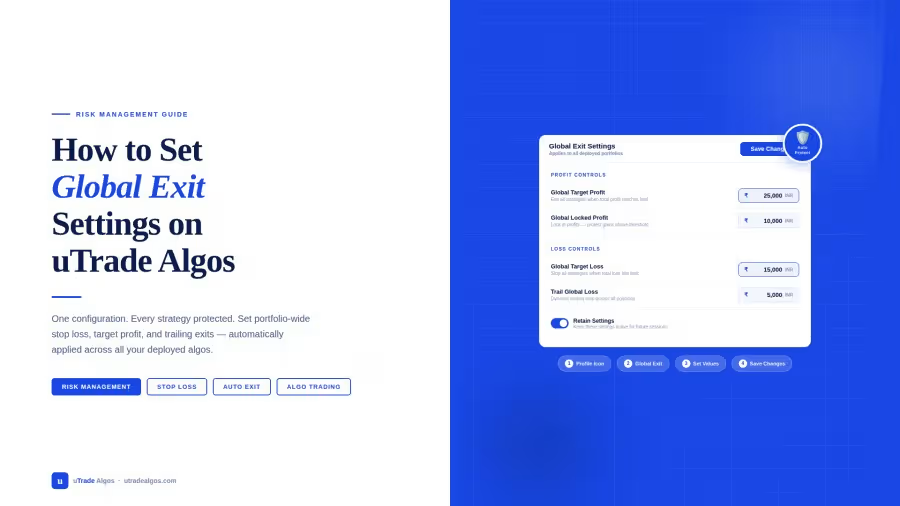
Risk management is often overlooked in manual trading, leading to large losses. Algo trading systems automatically apply rules such as stop-loss, position sizing, and capital allocation. This ensures that risk is controlled consistently across all trades.
7. Better Efficiency
A manual trader can only monitor a limited number of stocks or strategies at a time. Algorithmic systems can track multiple markets and execute several strategies simultaneously. This increases efficiency and allows traders to take advantage of more opportunities without additional effort.
8. Easy Scalability
As traders grow their capital, managing trades manually becomes more difficult and stressful. Algo trading makes scaling easier by applying the same strategy across larger capital without increasing workload. This allows traders to expand their operations smoothly.
9. Backtesting Power
Before using a strategy in live markets, it is important to understand how it would have performed in the past. Algorithmic trading platforms provide backtesting tools that allow traders to test strategies on historical data. This helps in making informed, data-driven decisions rather than relying on assumptions.
10. Constant execution
Consistency is key to long-term success in trading, but it is difficult to maintain manually. Algorithmic systems follow rules exactly as defined, every single time. They do not skip trades, overtrade, or deviate from the plan. This consistency improves overall performance over time.
Based on reports from NSE Market Pulse (mid-2025) and Business Standard (July 2025), the claim that algorithmic trading ("algos") accounted for approximately 70% of the equity derivatives (F&O) turnover in NSE in FY2024-25 is true
Conclusion
The way you trade should change along with the market. Relying solely on manual execution puts you at a distinct disadvantage in a world where success is defined by speed, discipline, and consistency.
Institutions are no longer the only ones using algorithmic trading. It is now usable, practical, and designed for retail traders who wish to trade more intelligently rather than more laboriously. It eliminates emotional errors, enhances performance, and assists you in adhering to your plan precisely—something that most traders find difficult to do on a regular basis.
Frequently Asked Questions (FAQS)
Which Algo Trading Software Offers the Best Features for Indian Stock Markets?
There are multiple algo trading platforms available in India today, each offering different features depending on your needs—like strategy building, automation, backtesting, and broker integration.
Algo trading the smart way of trading
Do I need coding skills to start algo trading?
Not anymore. Many modern platforms lijke uTrade Algos offer no-code or low-code solutions, allowing you to build and deploy strategies without programming knowledge.
Is algo trading safe and legal in India?
Yes, algo trading is legal in India when done through approved brokers and platforms. It’s important to follow SEBI guidelines and use systems that include proper risk management like stop-loss and position sizing.
How can I start algo trading as a beginner?
Start by learning basic strategy concepts, then use a platform like Utrade Algos where you can test (backtest), try ready-made strategies, and go live gradually—without needing deep technical knowledge.
Also Read:
How to create an account for algo trading?
How will uTrade Algos help me as a beginner trader?
What is Algorithmic Trading? Everything You Need to Know




.svg)





