
.avif)
Introduction
Every trader has felt it. You enter a trade with full confidence—and then freeze when it's time to exit. Do you hold a little longer? Did you exit too soon? Was that the peak?
This indecision is where most traders lose money—not at entry, but at exit.
Whether you're trading Nifty options in Mumbai, running a stock basket in Bengaluru, or scalping Bank Nifty from a laptop in Chandigarh, your exit strategy ultimately decides the outcome.
So, whether you are searching for
“When to Exit a Trade?”
“Exit Plan for Every Trading Style,”
Time-based exits, or simple and effective exit trading strategies,
This blog has your answers as we break down the two most common approaches—Time-Based Exits and Target-Based Exits—and show you exactly how uTrade Algos makes both effortless and automatic.
What is an Exit Strategy?
An exit strategy is a pre-decided plan that tells you—or your algo—exactly when to close a position. It includes your profit target, your loss limit, and sometimes a time-based rule as a backup. Think of it as your trade’s “endgame,” set in stone before emotions get involved.
How many types of Exit Strategy are there?
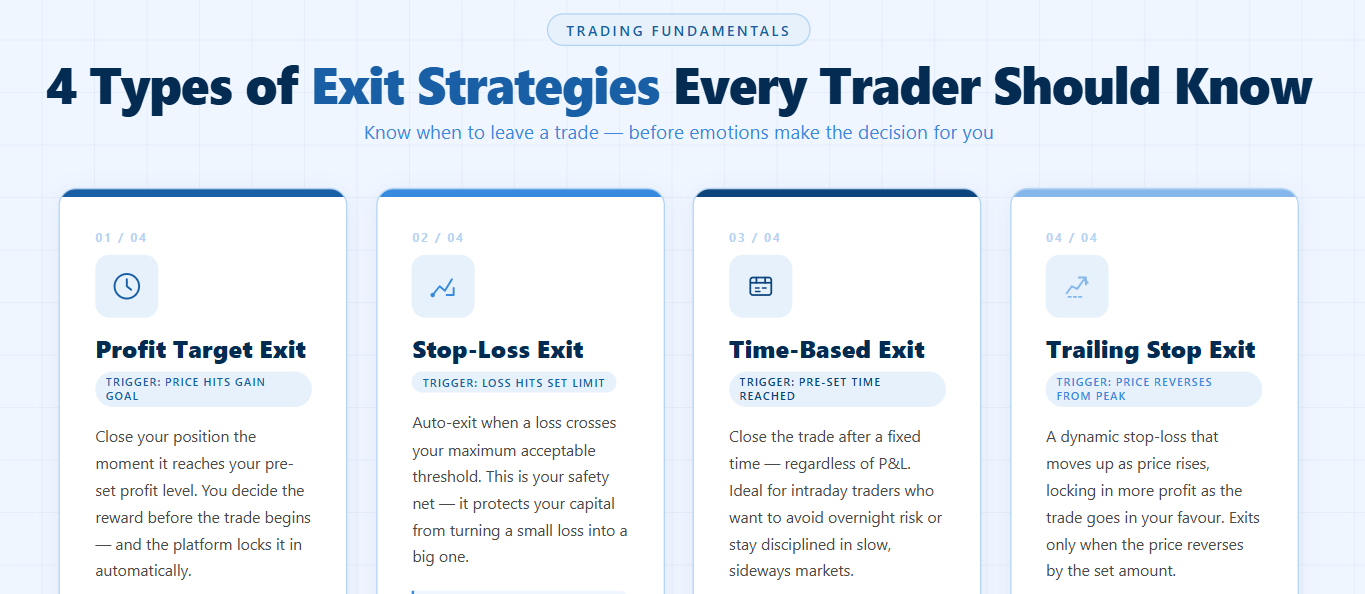
What is a Time-Based Exit Strategy?
Definition: In a time-based exit strategy, you exit your position after holding it for a fixed period, regardless of price movement or target.
Examples: “Exit all trades at 3:15 PM,” or “Exit after 15 minutes from entry.”
What Are the Pros and Cons of a Time-Based Exit Strategy?
Pros:
- Removes emotion: A preset exit time enforces discipline.
- Captures intraday moves: Useful in Indian intraday trading, where volatility and liquidity peak at certain times.
- Simplifies algo logic: Easy to implement and backtest.
Cons:
- May miss big moves: The exit could happen before a big late move in your favor.
- Ignores price action: No consideration for whether the stock/option is nearing the target or stop-loss.
Note: These limitations can be improved with the right strategy or by combining multiple exit rules, which we’ll cover later in this blog.
When Does a Time-Based Exit Strategy Work Best?
- High-frequency or scalping strategies
- During events with known time windows (news, RBI policy releases)
- When markets are range-bound or choppy
What is a Target-Based Exit Strategy?
Definition: In a Target-Based Exit Strategy, you exit your trade only when the price hits a pre-defined target (profit or stop-loss).
Examples: “Book profit at +₹500 per lot” or “Exit if the loss crosses -₹1,000.”
What Are the Pros and Cons of a Target-Based Exit Strategy?
Pros:
- Captures bigger price moves: Captures bigger moves when they occur.
- Risk management: Protects capital by limiting losses at a predefined level.
- Emotionally satisfying: Provides a clear win/loss outcome for every trade.
Cons:
- May not hit target/stop-loss: In sideways or low-volatility markets, positions may remain open for too long.
- Risk of reversals: Waiting for the target can lead to giving back profits if the price reverses before reaching your level.
Note: These limitations can be improved with the right strategy or by combining multiple exit rules, which we’ll cover later in this blog.
When Does a Target-Based Exit Strategy Work Best?
- In trending markets where price moves are strong and directional
- For options strategies with defined risk (straddles, spreads, iron condors with MTM exits)
- When you are able to monitor positions or automate exits
Time-Based vs Target-Based Exits: Which Works Better?
Honestly, there’s no “one-size-fits-all” approach. The best choice depends on:
Your trading style (scalper, day trader, swing trader)
The product (stocks, options, futures)
Market conditions such as volatility, trend, and liquidity
Most professional traders use a combination of both strategies. Here’s a simple rule of thumb:
In a trending market, → Target-based exits work better (ride the wave to your goal)
In a flat or choppy market, → Time-based exits can protect you from false signals
Best practice → Use target-based exits, but add a time rule as a backup (e.g., “Exit at target or after 5 days, whichever comes first”).
How uTrade Algos Automates All of Them for Traders
Whether you are a beginner or an experienced trader, uTrade Algos helps you automate your exit strategies in a smart and stress-free way.
1. Automated Target-Based Exits
- Profit Target: You can set a profit goal (for example: exit when profit reaches ₹5,000).
- The system continuously tracks your MTM (Mark-to-Market) profit in real time.
- As soon as your target is reached, the platform automatically sends an order to square off positions.
How this helps:
You don’t miss booking profits due to hesitation, emotions, or being away from the screen.
2. Automated Stop Loss Exits
- MTM (Mark-to-Market) Stop Loss: You can set the maximum loss you are willing to take (for example: -₹2,000).
- The system checks your loss at every market tick.
- If the loss limit is hit, all positions in your strategy are automatically closed.
How this helps:
It ensures strong risk management and protects you from big losses during sudden market moves.
3. Time-Based Exits
- Scheduled Exit Time: You can set a fixed time (for example: 3:15 PM) or a condition like “exit after X minutes of entry.”
- The platform tracks time automatically—no need to keep watching the clock.
- At the set time, all trades are squared off.
How this helps:
It avoids accidental carry-forward positions, reduces overnight risk, and keeps you aligned with market closing rules.
4. Hybrid (Combined) Exits
- You can combine multiple conditions like:
“Exit at profit target OR stop loss OR time—whichever comes first.” - The system monitors all conditions together and executes automatically.
How this helps:
You get complete control—lock profits, limit losses, and exit safely before market close.
5. Simple Setup (No Coding Needed)
- You can easily set target, stop loss, and time using a simple dashboard (GUI).
- For advanced users, options like uAlgoScript / YAML are available.
- You can also backtest your strategy using historical data before going live.
How this helps:
Even beginners can use it easily, while advanced traders can build more complex strategies.
6. Instant and Emotion-Free Execution
- No fear, no greed, no delay—everything is handled by the system.
- Trades execute automatically even if you are not watching the screen.
How this helps:
Removes emotional decision-making and improves trading discipline.
7. Reports and Alerts
- Get instant notifications/alerts when an exit happens.
- Check detailed Exit Logs to see why and when a trade was closed.
How this helps:
Gives full transparency and helps you learn and improve your strategy.
Disclaimer: Automated exits work as per your defined logic and internet/broker connections. Always test before live trading.
Conclusion
Trading success doesn’t just depend on how you enter a trade—it largely depends on how you exit it. Whether you choose a time-based exit strategy for discipline or a target-based exit strategy to capture price moves, both have their strengths and limitations.
The key is not choosing one over the other, but understanding when to use each—and when to combine them. Most professional traders rely on a mix of both to balance profit, risk, and timing.
With platforms like uTrade Algos, you don’t have to rely on emotions or manual monitoring. You can automate your exits, follow a clear plan, and trade with confidence and consistency.
Frequently Asked Questions (FAQs)
What is the best exit strategy for intraday trading in India?
For intraday trading, a combination of time-based and target-based exits can work well, especially when paired with a defined stop-loss and exit timing. However, there is no one-size-fits-all approach—traders should evaluate what suits their strategy and risk appetite.
It’s always recommended to test and backtest your exit strategy before using it in live markets. You can try and backtest different exit strategies on the uTrade Algos platform to see what works best for you.
How do I decide when to exit a trade in options trading?
You can exit based on profit targets, stop-loss levels, or time-based rules, depending on your strategy and market conditions.
Is a time-based exit strategy better than a target-based exit?
Neither is universally better—it always depends on your strategy and market conditions. Time-based exits work well in choppy markets, while target-based exits perform better in trending markets.
Can I combine multiple exit strategies in algo trading?
Yes, combining exit strategies (target, stop-loss, and time) is common and helps improve risk management and consistency.
How does uTrade Algos automate exit strategies for traders in India?
uTrade Algos allows you to set profit targets, stop-loss, and time-based exits, and automatically executes trades when conditions are met.
.avif)
.avif)
.avif)
.avif)
.avif)
.avif)
.avif)

.svg)





