
.avif)
Introduction
Every day, crores of Indians open their phones, check the Sensex, and wonder — "Should I be investing in this?" The stock market can feel like a world only meant for finance experts and rich businessmen. But here's the truth: the basics of the stock market are simpler than you think, and starting your stock trading journey in India has never been easier.
What is the Stock Market?
The stock market is a place where people buy and sell shares of companies. When you buy a share, you become a small owner of that company.
In simple words, the stock market allows businesses to raise money and gives investors an opportunity to grow their wealth over time.
The stock market consists of a primary market in which businesses first issue shares to investors and a secondary market in which investors trade shares.
Most daily stock market trading happens in the secondary market through stock exchanges like the National Stock Exchange (NSE) and the Bombay Stock Exchange (BSE).
If you have ever wondered what stock trading is or what trading is, the answer is simple: stock trading means buying and selling shares with the aim of making a profit from price movements. India's stock market has become one of the fastest-growing financial markets in the world, with millions of new investors joining every year.
Key Takeaways
- The stock market is a platform where shares of companies are bought and sold.
- Stock trading involves buying and selling shares to earn profits.
- Investors use stock exchanges such as NSE and BSE for trading in stock market.
- The Indian stock market is regulated by SEBI to protect investors.
- A Demat account and a trading account are required to start stock market trading.
- Platforms like uTrade Algos provide beginner-friendly tools, pre-built strategies, and AI-powered insights to help traders make smart trading decisions.
How Does Stock Trading Work?
Today, stock trading can be done directly from your phone or computer using a trusted and registered trading platform such as uTrade Algos.
Let's understand the complete process step by step.
Imagine Rohan wants to buy shares of a company.
Did You Know?
- The Bombay Stock Exchange (BSE) was established in 1875 and is one of Asia's oldest stock exchanges.
- India is home to millions of active investors who participate in the stock market every day.
Step 1: Open a Demat and Trading Account
Before starting, Rohan opens a Demat account and trading account. These accounts are required to buy, sell, and hold shares electronically.
Step 2: Add Funds
Rohan transfers ₹5,000 from his bank account to his trading account.
Step 3: Search for a Stock
Using the trading platform, he searches for a company whose shares are currently trading at ₹100.
Step 4: Place a Buy Order
Rohan decides to buy 10 shares.
He places a buy order through the platform.
Step 5: Order Reaches the Stock Exchange
The order is sent to the stock exchange (NSE or BSE), where the system looks for someone willing to sell those shares at the same price.
Once a buyer and seller match, the trade is executed.
Step 6: Shares Are Added to the Demat Account
After the transaction is completed, the 10 shares are credited to Rohan's Demat account.
Now he officially owns those shares.
Step 7: Monitor the Investment
Over the next few days or weeks, Rohan tracks the share price using his trading platform.
Step 8: Sell the Shares
When the share price rises from ₹100 to ₹120, Rohan decides to sell his 10 shares.
He places a sell order through the platform.
Step 9: Money Is Credited
Once another buyer purchases the shares, the transaction is completed and the sale amount is credited to Rohan's trading account.
His profit is:
- Buy Price = ₹100
- Sell Price = ₹120
- Profit Per Share = ₹20
Since he owned 10 shares, his total profit is ₹200 (excluding brokerage charges and taxes).
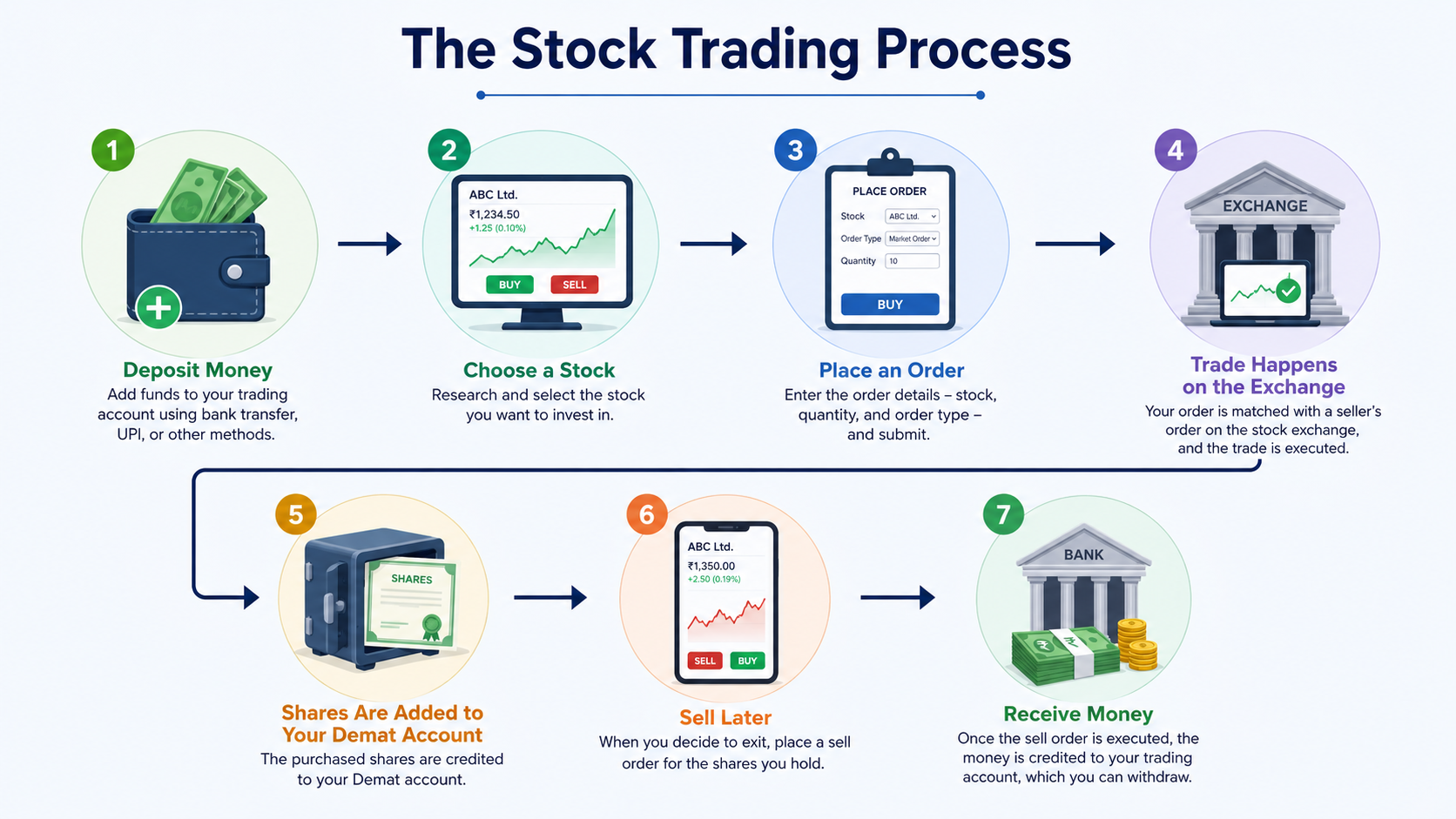
Modern platforms like uTrade Algos make this process easy by providing market access, charting tools, pre-built strategies, and AI-powered features that help traders analyze opportunities and place trades more efficiently.
When Do You Need a Trading Strategy?
A trading strategy comes into play before you place a buy or sell order.
Many beginners make the mistake of buying stocks simply because they see them going up or because someone recommended them. However, experienced traders usually follow a predefined strategy.
A trading strategy helps answer questions such as:
- Which stock should I buy?
- At what price should I enter?
- When should I exit the trade?
- How much money should I risk on one trade?
- What should I do if the trade goes against me?
Now, as a beginner trader, you don't need to worry about researching the market all day, understanding complex financial jargon, or creating a strategy while not being sure whether it will work or not.
That's where uTrade Algos helps make trading smarter and faster for traders through:
Pre-built strategies – Choose from ready-to-deploy trading strategies that come with backtesting and risk management features, helping you start faster with no coding required.
Strategy creation tools – Build, customize, and test your own trading strategies without writing a single line of code.
AI-based tools (uTrade Intelligence) – Get AI-powered insights and market analysis to help identify potential trading opportunities and make more informed decisions.
Conclusion
The National Stock Exchange (NSE), launched in 1992, brought electronic trading to India and transformed the way people trade.
Today, investors can buy and sell stocks directly from their smartphones using a stock trading app.
And now, with artificial intelligence and technology, institutional-level trading opportunities are available to retail traders, which is why more and more people in India are starting trading these days.
Beginner-friendly trading platforms like uTrade Algos are designed to help traders in India trade smarter with AI-powered algo trading and strategy-building options without coding.
Many people first learn about the stock market through news, social media, or even popular stock trading movies such as Scam 1992 and The Big Bull, which sparked curiosity about investing and trading among Indians.
The stock market offers opportunities for wealth creation, but success comes from learning, patience, and discipline. Start small, understand how the market works, and focus on building knowledge before taking bigger risks. In stock trading, never ignore risk management and logical decision-making. Using the right platform and tools can help traders make more informed and disciplined trading decisions.
Frequently Asked Questions (FAQs)
Where can I find advanced charting tools for technical analysis?
Many trading platforms offer charting tools, but traders looking for AI-powered market analysis can use uTrade Algos. Its uTrade Intelligence feature helps traders analyze market trends, identify opportunities, and make more informed trading decisions.
How do I open a Demat and Trading Account in India?
Opening a Demat and Trading Account is simple:
- Choose a registered broker or trading platform.
- Complete the online application form.
- Submit your PAN card, Aadhaar card, and bank account details.
- Complete the KYC verification process.
- Once approved, your Demat and Trading Account will be activated and ready to use.
Is a Demat Account necessary for starting stock trading in India?
Yes. If you want to buy, hold, and sell shares in the Indian stock market, a Demat account is generally required. It stores your shares electronically, while a trading account allows you to place buy and sell orders.
How much money do I need to start stock trading in India?
There is no fixed minimum amount required. Many beginners start with a small investment and gradually increase their capital as they learn more about the stock market and trading.
Can beginners use algo trading platforms?
Yes. Modern platforms like uTrade Algos offer beginner-friendly features such as pre-built strategies, no-code strategy creation tools, backtesting, risk management features, and AI-powered insights, making algo trading more accessible even for new traders.
.avif)
.avif)
.avif)
.avif)
.avif)
.avif)
.avif)

.svg)





