
.avif)
Introduction
Every trader knows that a good strategy and disciplined execution are everything. Yet, one important factor often gets ignored: are you using index options or stock options? That’s where platforms like uTrade Algos come into the picture — helping retail traders explore smarter ways to approach trading and find answers to questions that truly impact their strategy.
If you’ve spent any time building or backtesting algo strategies in the Indian markets, you’ve probably been stuck on this question: Should I trade index options (Nifty, Bank Nifty, Fin Nifty) or stock options (Reliance, HDFC Bank, Infosys)?
Honestly, there’s no universal “better” choice. But there is a better fit — depending on how your algo is built, what you’re optimizing for, and how much complexity you’re willing to manage.
Let’s break it down properly.
What's the Difference?
Index Options
Index options are based on a market index, like NIFTY 50 or BANKNIFTY. An index is not one company. It's a group of large companies tracked together as a single number that reflects how the overall market is doing.
So when you trade an index option, you're taking a view on the entire market's movement — not any one business.
Example: Your algo detects a steady upward trend in the broader market. It buys a NIFTY Call option. If the overall market rises, that option gains value. No single company's news can shake this on its own — it takes a much bigger shift to move an entire index.
Suggested read:
What Is Algo Trading Nifty and How Does it Work?
Stock Options
Stock options are based on a single company, like Reliance, Infosys, or HDFC Bank. Everything here depends on what that one company does.
Example: Your algo spots a bullish signal on Infosys. It buys an Infosys Call option. If Infosys stock goes up, the option gains value. But if Infosys drops — because of a weak earnings report, a management change, or any company-specific news — that option takes the hit, even if the rest of the market is doing fine.
Suggested Read:
How to Calculate Option Premium for Call and Put Options
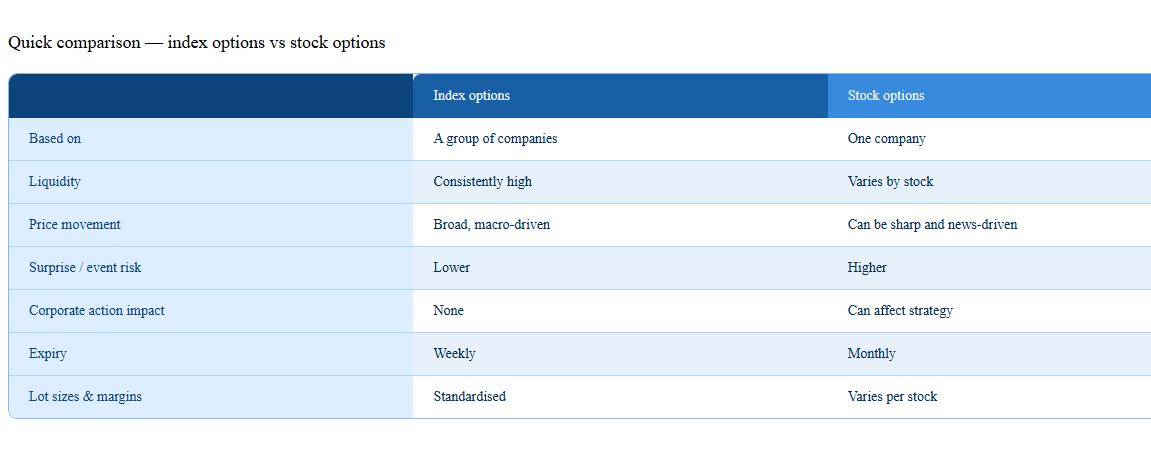
How They Behave Differently in Algo Trading
To understand which one suits your strategy, let’s look at how they behave in real market conditions.
1. Liquidity
Index Options — NIFTY and BANKNIFTY have very high trading activity. There are almost always buyers and sellers available, making it easier to enter and exit trades.
Stock Options — Liquidity varies a lot. Big stocks have decent activity, but many others don’t. This means trades may not always happen at the expected price.
2. Price Movement
Index Options — Move based on overall market factors like RBI decisions, global news, and general sentiment. One stock’s movement doesn’t impact the index too much.
Stock Options — Can move very fast, sometimes 5–15% in a day. Company news or events can cause sudden, sharp moves that are harder to predict.
3. Unexpected Events
Index Options — Not affected by company-specific news like earnings or management changes. Movements are usually broader and more gradual.
Stock Options — A single news event can completely change the price behavior overnight, even if the overall market is stable.
4. Corporate Actions
Index Options — Not impacted by stock splits, bonuses, or dividends.
Stock Options — These events can change option data and may affect how strategies behave if not handled properly.
5. Expiry Structure
Index Options — Usually have weekly expiries in India, offering more frequent trading opportunities.
Stock Options — Mostly monthly expiries, which can change how short-term strategies are designed.
6. Lot Sizes & Margins
Index Options — More standardized, making capital planning easier.
Stock Options — Lot sizes and margins differ across stocks, adding another layer of complexity.
Suggested read:
What to Consider When Choosing Between Puts and Calls in Algorithmic Trading
Index Options vs Stock Options: Which One Should You Choose?
There’s no one answer — it always depends on your strategy, market conditions, and your experience level.
For Beginners in Algo Trading
Index options are usually a better starting point.
They offer:
- More consistent price movement
- Easier strategy building
- Lower impact from unexpected news
This helps you focus on learning how algos work without too many unpredictable factors.
For Experienced Traders
Stock options can offer more opportunities if used carefully.
They allow:
- Targeted trading on specific stocks
- Higher movement potential
- More strategy variations
At the same time, there is no single “best” choice. It always depends on market conditions, your strategy, your experience level, and your intuition.
For example, there are times when an index is moving up mainly because of a few heavyweight stocks. In such situations, even a beginner might find stock options more relevant depending on the setup.
A Practical Approach
Rather than choosing one over the other completely, many traders tend to explore both over time.
Some may begin by testing strategies in index options and later look at stock options as they gain a better understanding of market behavior and risk. Others may directly work with stock options if their strategy is built around specific stocks.
In the end, there isn’t a fixed path. What matters is having a clear understanding of the basics, being aware of market conditions, and aligning your approach with your own observations and intuition.
Suggested read: 5 Technical Indicators that Traders Should Know
How does uTrade Algos help traders navigate both index and stock trading?
For many traders, the biggest challenge is not the idea — it’s execution.
Platforms like uTrade Algos simplify this by allowing you to:
- Access pre-built algo strategies
- Run trades without coding
- Test strategies across both index and stock options
- Monitor trades in real time
This makes it easier to experiment and understand what actually works for your trading style without getting stuck in technical complexities.
Conclusion
Choosing between index options and stock options is not about finding a universally better instrument — it’s about finding what fits your strategy.
Index options offer a more stable and predictable environment, making them suitable for traders who want consistency and smoother execution. On the other hand, stock options bring more movement and flexibility, which can open up opportunities but also add complexity and risk.
For most traders, especially those starting with algo trading, beginning with index options and gradually exploring stock options is a practical approach. It allows you to build confidence, understand market behavior, and refine your strategy without being overwhelmed.
In the end, the effectiveness of your algo depends not just on how it is built, but also on where it is applied.
Frequently Asked Questions (FAQs)
Are index options better than stock options for algo trading in India?
Index options are generally considered better for beginners because they are more liquid and less affected by sudden company-specific events. However, stock options can offer more opportunities for advanced strategies.
Can I use algo trading for stock options in India?
Yes, stock options can be used in algo trading. However, they require more advanced strategies due to factors like lower liquidity, sudden price movements, and company-specific news.
Can I run the same algo strategy on both index and stock options?
Not always. A strategy built around index options assumes consistent liquidity and macro-level movement. The same logic applied to a stock option might behave very differently due to lower liquidity, wider spreads, or an unexpected news event. Strategies often need to be adjusted based on the instrument.
Why does liquidity matter so much in algo trading?
Algos place orders based on calculated prices. If the market doesn't have enough buyers and sellers at that price point, your order gets filled at a different price — this is called slippage. Over hundreds of trades, slippage adds up and can significantly affect your actual returns vs. what your backtest showed.
Is algo trading with options legal in India?
Yes, completely legal. You need to trade through a SEBI-registered broker. No special restriction on index vs stock options — except that stock options under F&O ban can't have fresh algo orders placed on them.
.avif)
.avif)
.avif)
.avif)
.avif)
.avif)
.avif)

.svg)





