
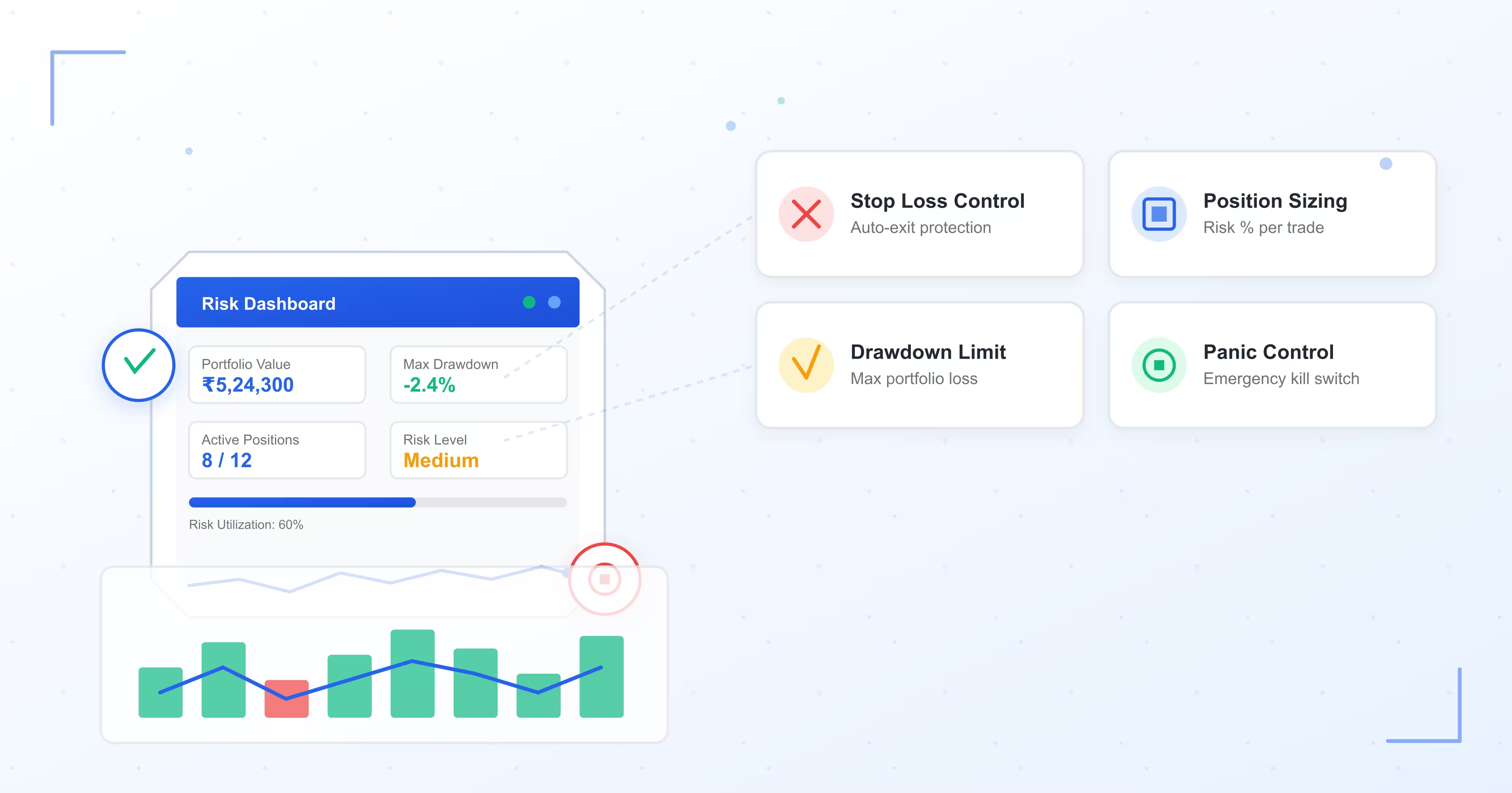
Your algo may be 100% correct—and you can still blow your account.
Here’s why: One large position, a flash crash during your sleep, or a system failure can undo months of profits in minutes. Automated trading moves fast, and so will your losses if you don’t set the right risk controls.
The distinction between algo traders who succeed and those who fail is not strategy—it’s risk management. In this guide, you will learn the same framework that successful traders use to safeguard their accounts while allowing their algos to run.
Why Risk Management Makes or Breaks Your Algo Trading
Think your algorithm will stop itself when things go wrong? Think again.
Here's why risk management is non-negotiable:
- Speed cuts both ways – Automated trading executes in milliseconds, which means losses pile up just as fast as profits
- The 2010 Flash Crash lesson – $1 trillion vanished in 36 minutes because algorithms without risk controls kept selling into the crash
- Automation ≠ Safety – Emotions are removed, but system failures, connectivity issues, and market shocks aren't
- Access matters – Platforms like uTrade Algos democratize institutional-grade risk controls through a no-code, algo AI lead trading platform.
- Visual controls – Set position limits, stop losses, and emergency switches without writing a single line of code
You can have the most profitable strategy in the world, but without proper risk management in algo trading, one bad day can erase months of gains.
But before you implement any controls, you need to understand what you're protecting against. Let's break down the specific risks lurking in every automated trade.
Types of Risk in Algo Trading You Can't Ignore
All trades executed by automated trading systems are exposed to three types of threats. Knowledge of these threats is the first step towards safeguarding your investment.
Market Risks
- Directional risk – Price moves against your trade (your long position collapses, or your short position gets squeezed out).
- Volatility risk – Sudden market swings and spikes that surge past your stop-loss orders before execution.
- Gap risk – Overnight or weekend market gaps that open far beyond your stop-loss or exit points (earnings reports, global political events).
Technical & Execution Risks
- Slippage and liquidity issues – Your trades are executed at worse market conditions than anticipated, particularly in highly liquid markets.
- System failures – Internet connectivity failures, server crashes, or broker API unavailability during market hours when you are actively trading.
- Algorithm errors – Glitches in your code that cause incorrect trades or corner cases or incorrect position sizing.
Strategy & Model Risks
- Overfitting – Your strategy crushes backtests but bleeds money live because it's too tailored to historical data.
- Correlation risk – Multiple strategies tank simultaneously because they're all tied to the same underlying factor.
- Outdated parameters – Market conditions change, but your algo keeps trading like it's 2020.
Now that you know what can go wrong, let's build a defense system. The framework below shows you exactly how to manage each of these risks in algo trading.
The Core Risk Management Framework for Algo Trading
Protection starts before you place your first trade. Here's the proven framework that keeps professional traders in the game.
Position Sizing – Your First Line of Defense
Never risk more than you can afford to lose on a single trade. Here are the three approaches that are the most effective:
- Percentage-based approach – Risk only 1-2% of your capital per trade. With a ₹50,000 account, that's ₹500-₹1,000 max risk per position.
- Volatility-adjusted sizing – Size positions based on ATR (Average True Range). Higher volatility = smaller position size, lower volatility = larger position size.
- Kelly Criterion – A mathematical formula that determines your optimal position size based on your win rate and risk-reward ratio.
How it works: Suppose your stop loss is ₹2 per share and you're risking ₹500. You can buy a maximum of 250 shares (₹500 ÷ ₹2).
uTrade Algos will automatically provide you with position size recommendations based on your preferred approach – no calculations required.
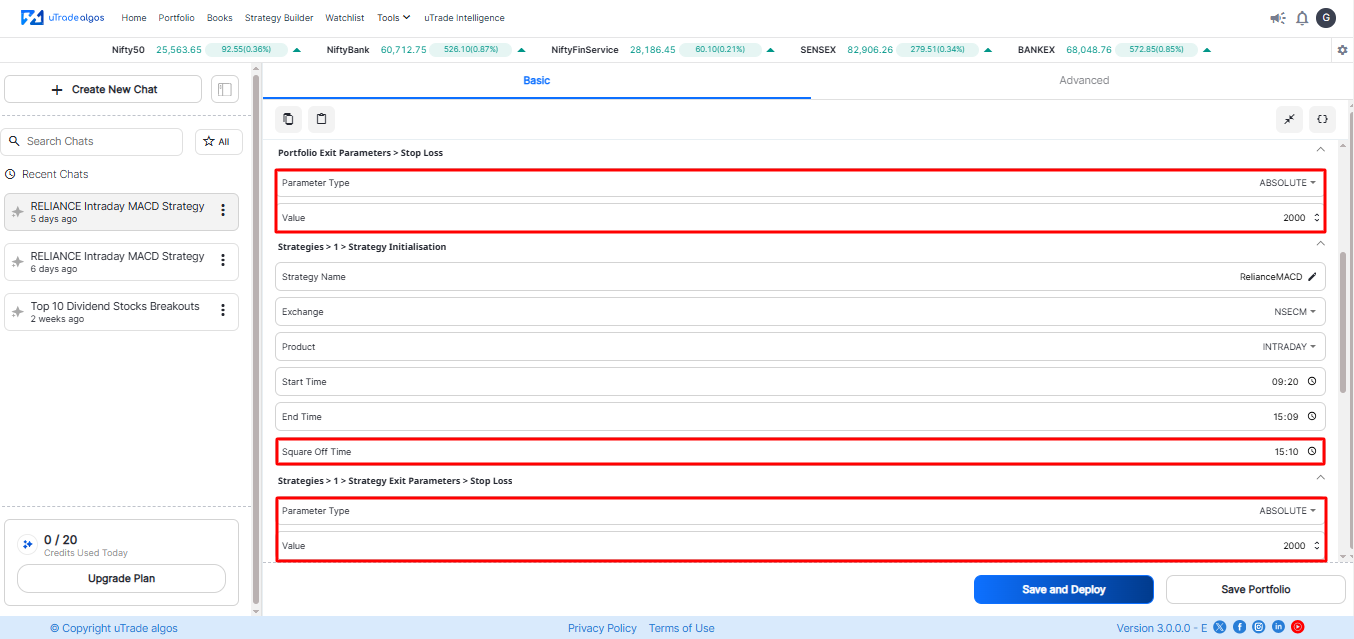
Stop Loss Strategies That Actually Work
Your exit strategy is more important than your entry strategy. There are three kinds of stops to protect different situations:
Fixed Stop Loss
- Fixed stops should be placed at logical points (support/resistance) and not at random percentage levels
- Example: Stock price is ₹500, support level is ₹485—stop loss should be placed at ₹483 (below support)
Trailing Stops
- Lock in profits while riding a trend
- Example: Stock price moves from ₹500 to ₹550. Your trailing stop, set at 5%, moves from ₹475 to ₹522.50
Time-Based Stops
- Exit positions that don't move as expected in 3-5 days
- Prevents capital from getting stuck in dead trades
Take Profit Targets – Exit Before the Reversal
Greed kills more traders than fear. Fix your exits:
- Minimum 1:2 risk-reward ratio – If risking ₹500, target at least ₹1,000 profit.
- Technical targets – Previous resistance, Fibonacci points, or round numbers.
- Partial booking – Take 50% profit at first target, let rest run with a trailing stop.
Example: Entry at ₹500, stop at ₹490 (risking ₹10), first target at ₹520 (profit of ₹20 = 1:2 ratio).
Portfolio-Level Controls
But individual trade limits are not sufficient. You need to safeguard your entire portfolio:
- Maximum drawdown limit – Pause all trading activity if your portfolio falls 10-15% from the highest point.
- Daily loss cap – Stop trading if you incur a loss of 3% in a day.
- Strategy diversification – Implement uncorrelated strategies (trend following and mean reversion).
- Correlation monitoring – Ensure your algos aren't all betting on the same market direction.
uTrade Algos monitors all these parameters in real time via a single interface, providing you with complete visibility without the spreadsheet chaos.
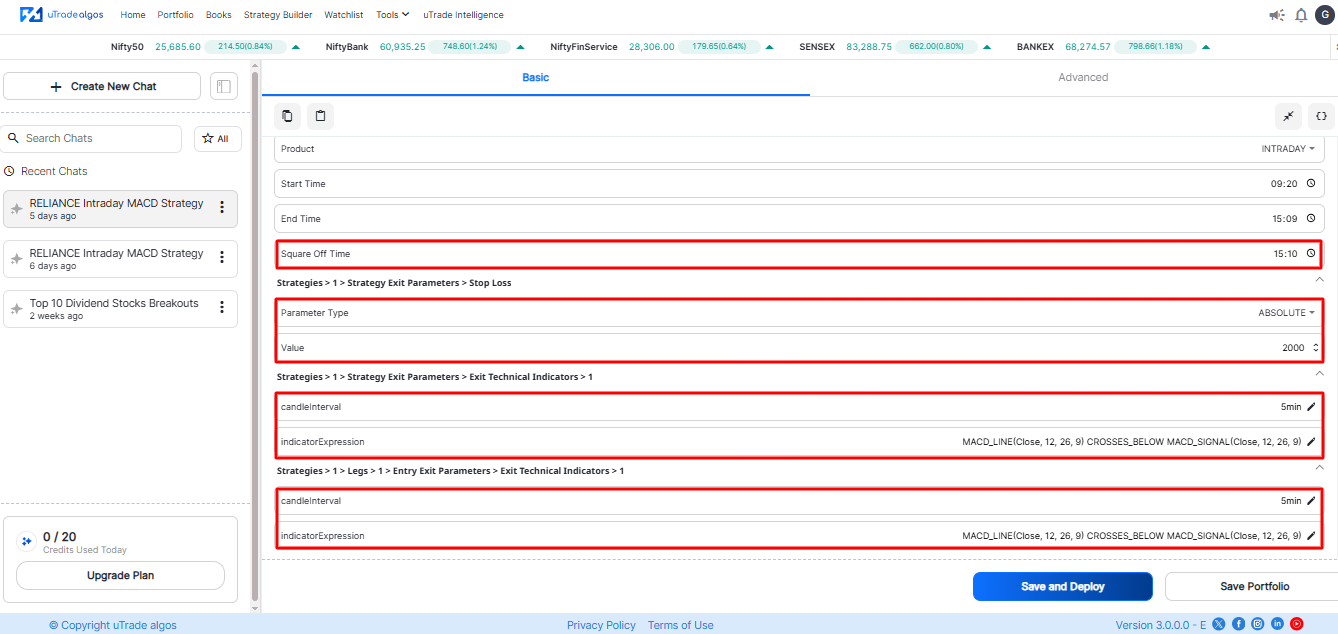
These basic parameters take care of 80% of risk management in algo trading. But what happens when markets go haywire? It's time to explore more sophisticated risk management techniques that come into play when markets become unpredictable.
Advanced Risk Management Techniques
Core controls shield you against normal market actions. These advanced techniques rescue you from a mess.
Circuit Breakers & Kill Switches
Automatic emergency stops that pause trading when things go haywire:
- Consecutive loss counter – Pause trading after 3-5 losing trades (to avoid revenge trading by your algo).
- Volatility spike detection – Stop all orders when VIX jumps 20%+ in an hour.
- Daily drawdown breaker – Completely shut down if you lose 5% of capital in one session.
Example: Your algo suffers 4 consecutive losses (₹2,000 each). The circuit breaker kicks in, preventing a potential ₹10,000+ drawdown day.
Real-Time Monitoring
Monitor what matters, when it matters:
- Live P&L monitoring – View profits/losses updated every second.
- Position exposure alerts – Receive alerts when you're over-exposed to a stock/sector.
- Slippage alert – Flag when actual execution prices vary 0.5%+ from expected prices.
- Performance vs benchmark – Compare your returns against Nifty/Sensex in real-time.
Key metrics dashboard: Max drawdown for the day, current win rate for the week, average slippage, largest open position.
These advanced risk management techniques sound complex, but implementation doesn't have to be. With the proper no code algo trading software, you can enable all these controls in minutes—no programming required.
How to Implement Risk Management in uTrade Algos
Here’s how you can implement institutional-grade risk protection in minutes—without coding.
uTrade Algos brings algo trading risk management accessible to everyone:
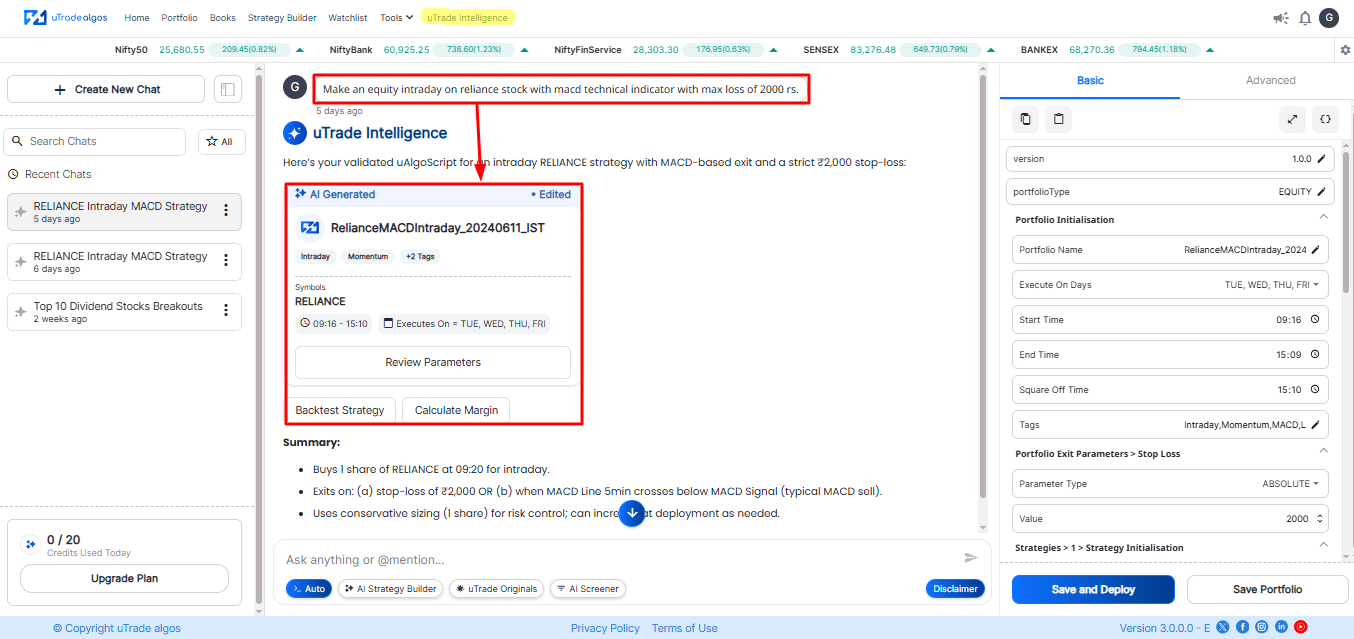
Step 1: Create Your Strategy with Built-In Risk Controls
Use uTrade Intelligence to develop risk-aware strategies through simple AI prompts, or develop customized strategies using the Strategy Builder. Visually define stop losses, profit targets, and position sizing with exact entry/exit conditions that match your risk tolerance.
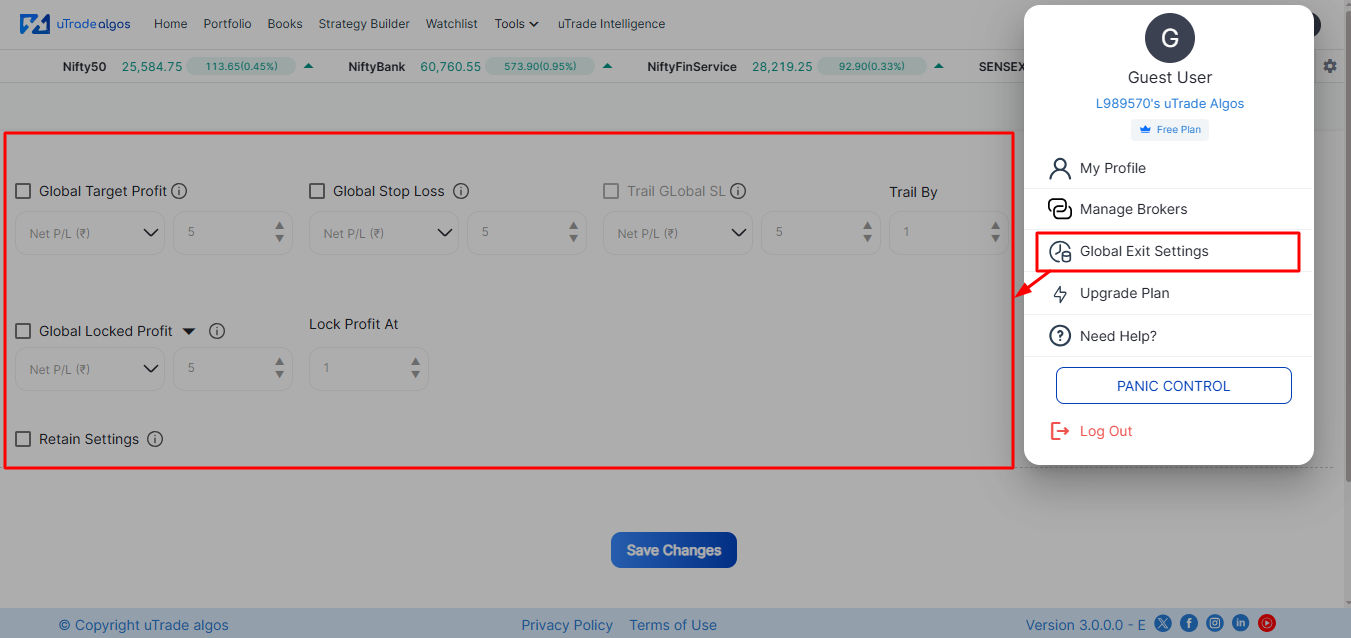
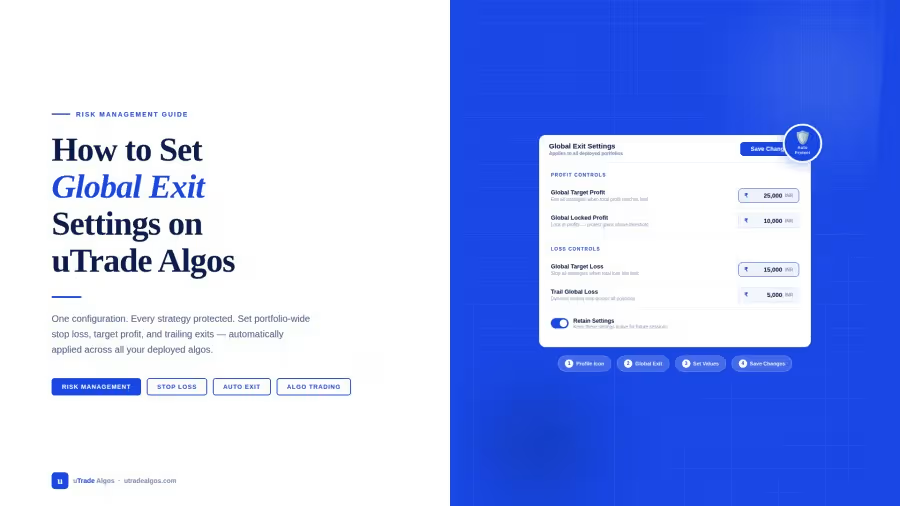
Step 2: Set Global Exit Settings
Set portfolio-wide risk settings—maximum loss limits, drawdown caps, and time-based exits that automatically apply across to all your strategies.
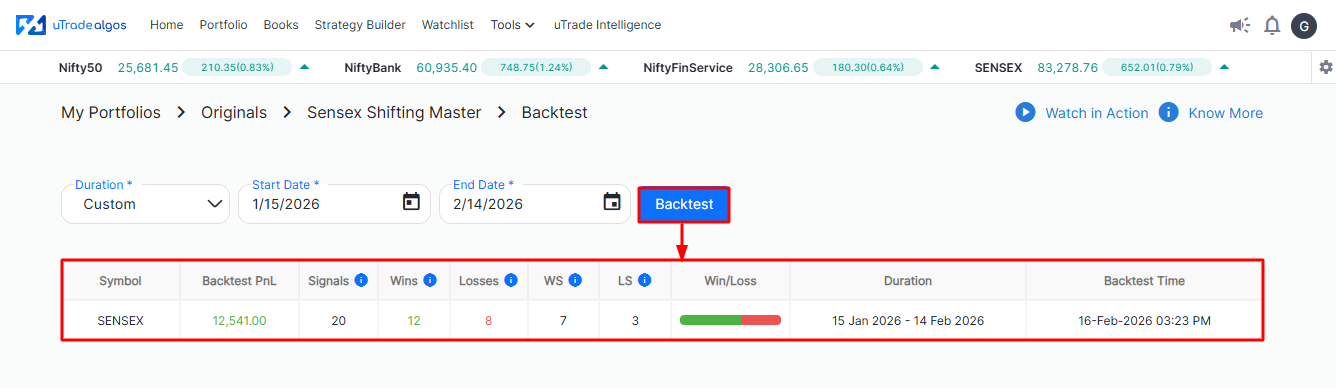
Step 3: Test Before You Trade
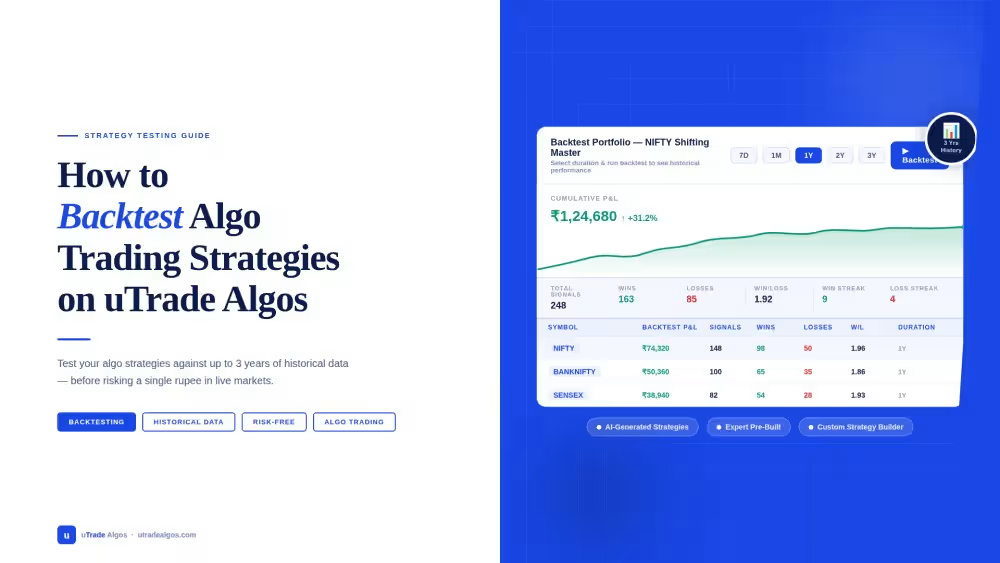
Run Backtesting on historical data to validate your risk parameters.
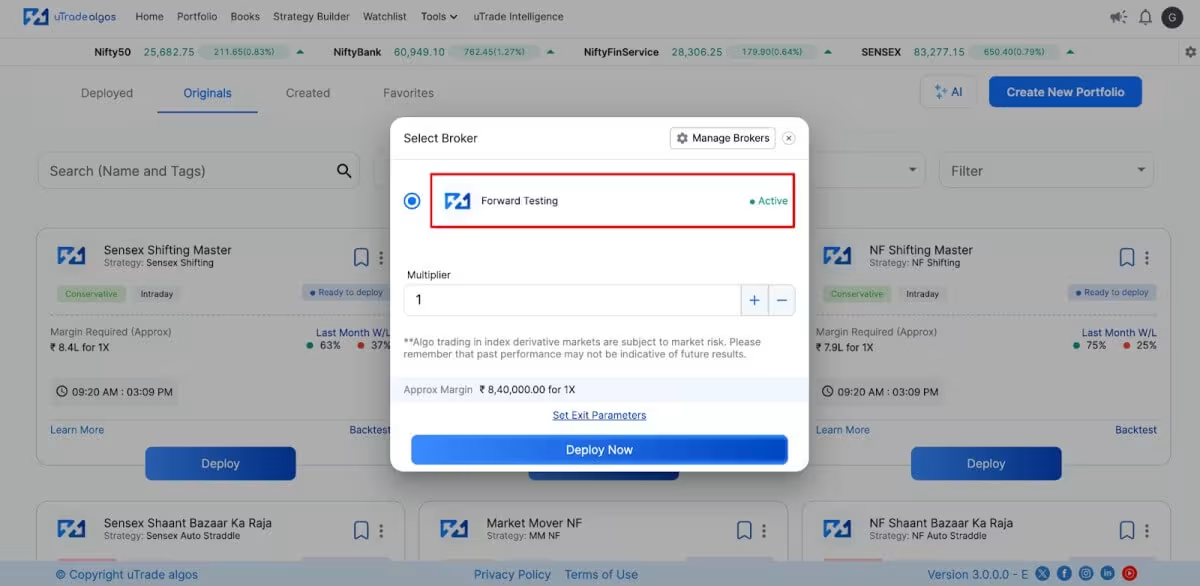
Use Forward Testing to check how controls perform in current live market conditions, with simulated trading, without risking capital.
Step 4: Deploy with Confidence
Activate Panic Control (one-click kill switch) for urgent situations. Monitor real-time performance from your dashboard—accessible from mobile or desktop.
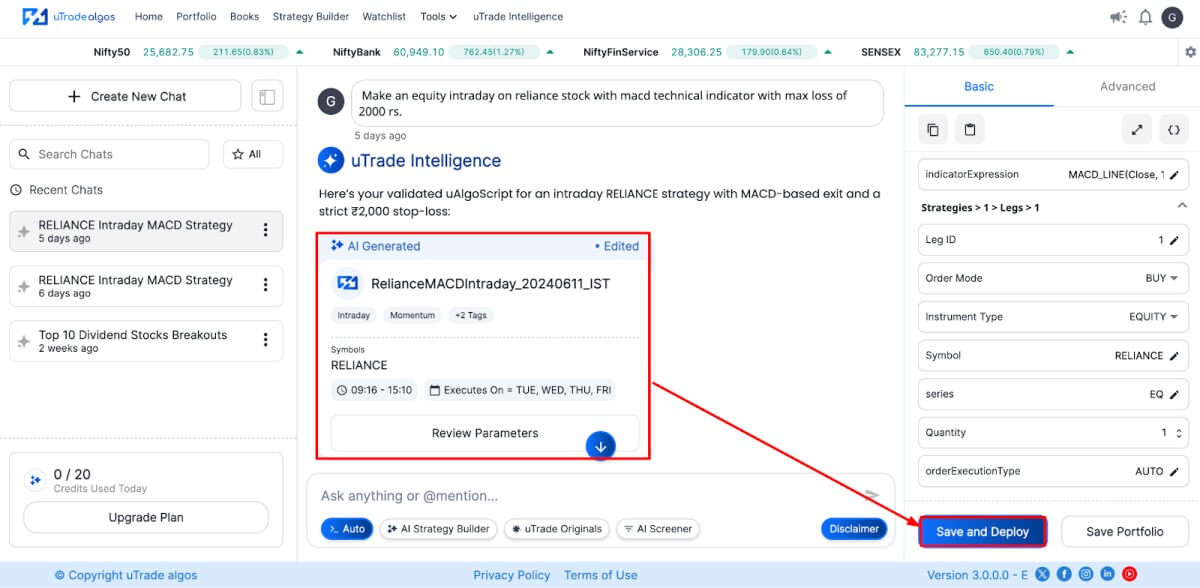
Setup time: Less than 10 minutes for complete protection.
Traders using these tools still commit fatal mistakes that can ruin their systems. Let’s examine the blunders that distinguish survivors from casualties.
Common Risk Management Mistakes to Avoid
Even with uTrade Algos doing the heavy lifting, these mistakes can still hurt your trading account:
Stop Losses Too Close to Entry Price
Having your stop loss just ₹5-10 away from the entry price means that normal market fluctuations will hit your stop loss before your strategy has a chance to succeed. Give your trades some breathing space.
Running Similar Strategies Together
If all your algos are buying Nifty IT stocks, they will all lose money when tech crashes. Diversify your strategies across sectors and types—don't put all your eggs in one basket.
Trading Without a Safety Net
Not setting a maximum loss limit is like driving without brakes. Use Panic Control in uTrade Algos to automatically stop trading when your losses reach your limit (set at 10% of capital, for example).
Making Backtest Results Too Perfect
Tweaking parameters until your strategy shows a 95% win rate in 2023 data means it won't work in 2024's different market conditions. Keep your strategies simple and practical.
Trusting Your Gut Over Your System
Disabling your algo's stop loss because you "feel" the market will turn around is how traders blow up their accounts. Trust the system you built.
A quick pre-launch checklist can avoid these errors before actual money is put on the line.
Risk Management Checklist Before Going Live
Before deploying your strategy, verify every safety mechanism is active:
✅ Position size calculator set up for 1-2% risk per trade
✅ Stop loss set up on every single trade (no exceptions)
✅ Maximum portfolio drawdown set up (10-15% recommended)
✅ Daily loss limit turned on (3-5% of capital)
✅ Emergency kill switch tested and accessible
✅ Correlation analysis of strategy (diversification check)
✅ Stress test performed on past volatile periods
One unchecked box = one potential disaster. Go through this checklist every time you launch or update a strategy on uTrade Algos.
Conclusion
Risk management is not about capping profits—it's about being around long enough to let those profits compound. The greatest algo trading strategy is irrelevant if it gets blown out by a single bad week.
With uTrade Algos' no-code algo trading platform, you can leverage institutional-grade built-in risk management validations without writing a single line of code, so you can focus on strategy while the system protects your capital.
Ready to trade smarter, not harder? Start creating protected strategies today.
Frequently Asked Questions
Can algo trading lose money even with risk management?
Yes. Risk management helps minimize losses and increase reliability, but it does not ensure profits. Even a protected strategy may suffer drawdowns in adverse market conditions. The aim is to survive through the losing phases and preserve funds until your advantage again makes your strategy profitable.
What is the 3-5-7 rule in trading?
The 3-5-7 rule is a guideline that recommends restricting losses to 3% in a trade, 5% in a day, and 7% in a week. It is a progressive risk management system that prevents small losses from compounding. If you breach any of these, it is advised to stop trading for the period and reassess your strategy to avoid making impulsive trading decisions.
How much should I risk per trade in algo trading?
In algo trading, experienced traders risk 1-2% of the total capital on every trade. This means that with a ₹1,00,000 account, the maximum risk per trade should be ₹1,000 to ₹2,000. This will ensure that even if you lose 10 trades in a row, your account will not be severely impacted, allowing your strategy sufficient time to recover and prove itself over multiple trades.
What are 5 risk management strategies?
The five must-have techniques are:
(1) Position sizing to control risk on each trade,
(2) Stop loss orders to set a risk limit,
(3) Take profit targets to lock in profits,
(4) Diversification of a portfolio among non-correlated strategies, and
(5) Maximum drawdown limits to temporarily halt trading during large losses.
Which algo trading platform helps with risk management?
uTrade Algos is a no-code algo trading platform with integrated risk management tools: automated position sizing, stop loss configuration, real-time risk monitoring, one-click kill switches, and risk templates. You can enjoy institutional-grade risk protection without coding.




.svg)





